loading...
Showing posts with label chavismo. Show all posts

Thursday, 1 December 2016

Dialogue ante-mortem

I am going to comment a short note by Carlos Ocariz, the mayor of Eastern Caracas, a masterpiece of political conciseness. This will explain perfectly why there is no hope that a dialogue can ever happen between the regime and anyone else.


Translation, step by step, with my comments.


To the Vatican, mediators and the people of Venezuela.

Note: it is not even directed to the regime. Only the parts that have a certain level of seriousness, or for whom a lot is at stake. As is implied in the rest of the message, the MUD at this point does not care anymore about what the regime has to say on those matters, it has become a waste of time to listen.

We ratify the coherence and dedication to the [good] fight considering the MUD communique

There is no need to read the detailed communique of the opposition umbrella group, MUD. This note is eloquent enough as you'll see. Ocariz states unambiguously that this is a fight, and henceforth the dialogue was an attempt at a truce. But the causes of the good fight are still present. He also implies that the ways of his own people, the Primero Justicia party, are their own but that they share the common core and goals with the other players of the MUD. In short, we are united no matter what people may have speculated. And our union is way stronger than what anyone may think, in particular the regime.

It is inhumane that the government, in front of the crisis it created and we all Venezuelan suffer [the consequences], does not fulfill its engagements. The Vatican and the mediators bear witness of our dedicated efforts.

The Vatican and the said mediators are pushed against the wall. Let's see if they dare to say that the opposition did not do its best, that it should do more. And were they to attempt to say such thing, a further crass moves to favor the regime blaming the opposition, they better be ready to show the evidence. That is: the credibility of the Vatican and the mediators is what is at stake now. The Vatican and its Pope, mind you!

Also it bears underlining that if the opposition accuses the regime of the crisis, what cannot be argued is that ALL Venezuelans are suffering its consequences. For this reason alone the regime should try harder than what it does. If it ever tried, for that matter.

The internal divisions between government groups blocks them from honoring their word, and Venezuelans cannot be subjected of the contradictions/vagaries within the government/regime [exact word to translate not available].

What we all knew, the problem is within chavismo. What the opposition points out is to the direct problem of chavismo, that one group, led by Diosdado Cabello, wants no negotiation, no compromise, whatsoever. There may or may not be more than two groups of power within chavismo, but the one that is blocking any solution, that is aggravating the crisis, is the group of Diosdado Cabello who knows that their final destiny is jail because of their involvement in drug trafficking. And that crime, my friends, cannot go through any form of international amnesty. There is nothing the opposition can do about that.

What Ocariz says here is that any political outcome needs to go through an internal chavismo resolution, if it has a chance to become a relatively peaceful national settlement. Because if the Cabello groups takes over the only possible outcome is violence. They are the ones to find a solution for the Cabello problem, even an amnesty of which te regime should assume full responsibility in case some judge later decides against.

To the mediators and the Vatican if the government does not fulfill its [last meeting] engagements, there will be no reunion on December 6.

Note the simplicity. The MUD is not standing up and leaving. It simply states that the regime made commitments that were to be fulfilled by December 6, commitments made of its own volition. There is no point in discussing further commitments, or evaluating those made before, if the regime does not do what it promised to do [release of more political prisoners, recognition of the National Assembly constitutional role at least for the objectives set then, such as the election of a new Electoral Board]. As soon as the regime does its self accorded part, the opposition will return to the discussion table.

In other words, still without addressing the regime by name, the opposition advises the mediators and the Vatican not to waste their time, the time of all of them, MUD included. The mediators either show that they have what it takes, or get out of town.

Gettysburg address this ain't, but in Venezuelan political lingo it is as close as it will ever get. I, for one, am impressed by this short note from Ocariz.

Thursday, 7 January 2016

A new geography of chavismo [Updated]

When political movements suffer a major set back they either go extinct or they reorganize for better days. This means that inside factions shift, balances change and the result of these glissando will be extinction or renewal. With events these last two weeks we can start seeing how this is shaping.


The regime lost bad on December 6 but not everyone inside lost the same. The big loser is Diosdado Cabello; he lost his soap box, a lot of protection and his ability to rule through fear. Maduro lost a lot for sure as the election was a referendum on his tenure. But he is still president while Diosdado is, well, not much more than a minority party representative. If for the sake of survival the rivalry between the two men has been put in the side burner a year ago when polls started to look bad, that rivalry still exists and the need for survival is now desperate.

With the army party slightly on the side as they are not willing to pay the political price of 17 years of misrule, with the corrupt chavista narco elite blamed internally for the catastrophic economic crisis, it is the hour of the radicals and they are going for it.

Maduro formed in Cuba and the Castro's viceroy is naturally fond of radicals. He did not advance them before because chavismo was a coalition of interests where displacing a single group could have dangerous snowball effects. But now he can because the other factions are stunned not only because they lost on 6D so badly but also that the people did not revolt to expel the MUD invaders and restore chavismo to revolutionary glory. I am not making this up, read their own words in the press.

The thing about radicals is that even if they lose a battle or an election they do not care much as to the why and how. They just care about pursuing their agenda at all costs since they truly believe that through its completion people will finally see the goodness of their proposal. Be it radical chavismo, IS or Marine Le Pen. Thus yesterday we saw Maduro finally imposing a cabinet more to his liking where the economy tsar/star is pure lefty, but someone without even a formal Marxist formation. Luis Salas is a prophet. He has had visions that inflation does not exist, that gas is not subsided, that Polar hides months of national production in a small warehouse somewhere. As a prophet now in charge he will demonstrate that his fantasy world was the truth that others failed to see and thus failed to seek.

If some of the chavista factions may be stunned they are not necessary totally oblivious. The army sent back to its barracks keeps a few seats, in particular the defense minister Padrino who was the guy that refused to commit electoral fraud a month ago. Some more sensible heads are still around such as the new vice president or a couple of economy ministers offering a strange balance to Salas. It should be noted that the new vice, Aristobulo Isturiz, would be a great president for a short transition in between Maduro departure and the election of its successor. In fact, Isturiz could well be the best candidate chavismo has to offer but is smart enough not to accept this late in life such a poisoned gift. President for a few weeks will suffice him.

Thus go the moves inside chavismo, the first serious realignment since the civilian faction was ousted when Ramirez and Giordani were expelled. Now the fight in earnest between the radicals and the bolibourgeois narco elite supported by part of the army has started.

We will see if some inside the PSUV have the nerve to form a third faction to avoid the final demise of the Chavez party.

I have my doubts.

--------------------
Update.
Rafael Poleo thinks that the new cabinet and the iconoclast wars are a strategy to remove Diosdado Cabello once and for all. I am not mentioning this because I concur, I am just noting it to illustrate the wide swath of speculation going on.

Saturday, 5 December 2015

The truth on the weeks after (elections YV-11)

So tomorrow we vote. And what will happen next?


First, a mea culpa of sorts. Until 2-3 weeks ago I still thought that the regime was going to find a way to suspend the election. It did not (well, it still has about 8 hours left). From this we can conclude that the regime is so aware of its defeat, and so aware that there is no way to recover part of the lost ground in a short time, that it decided to go ahead anyway and see what happens next. For me, that there are elections, is paradoxically a way for the regime to recognize in advance that they lost and cannot turn around the result in a "good and timely manner".

Tomorrow they certainly will do their utmost to gain votes even by forcing people to vote, even by carrying busloads of people at 10 PM to vote, etc...  After all they even jailed the head of Sucre district police and keep the police in their barracks so the colectivos of Sucre will have a free reign of terror to "bring in the vote". Yet, no matter what, these last minute despair tactics will be limited in scope (the world is watching) and they cannot change the fundamental event of the election: the power shift, the end of chavismo grip over the collective imaginary.

What happens tomorrow and Monday I have written about. Now as a responsible blogger I should pen down what I think may happen in the next weeks.

There are lots of OpEd around, speculating on what legally the new assembly can do whether the opposition MUD gains a simple majority or a supernumerary 2/3 majority. Other people already discuss the agreements that the regime and the opposition will have to reach. There is even talk of civility and Harina P.A.N. returning to our every day lives and shelves. I am not going to enter these discussions since even Monday morning, results in hand, it will be dangerous to speculate.

The reason that I do not want to partake in the guessing game is that we are not dealing here with a normal democratic regime which has become, shall we say, a little tense over the last decades. The regime has reduced itself to a gang of thugs and narco traffickers and with such people you cannot discuss, you cannot make an agreement. They eliminate you or you eliminate them first. This is the logic of street gangs. Force. Period.

For a speculation to make any sense it should start with the basic effect that the result will have over the inner divisions of chavismo. This movement can be divided roughly in three, for the purposes of this discussion.

One group has it all on line and will fight for its survival until the end. I am talking of course of the higher up in the regime which has dabbled in phenomenal corruption and, apparently, also ALL in drug trafficking now that we know that first lady Cilia Flores nephews are into DEA custody. This group that includes Cabello and Maduro are willing to go to the deep end.

The second group is the wavering one. Those did benefit from the regime but neither to the extremes of the first group, or not as much as they would have liked to. The point for that group is that many do not feel the need to immolate themselves for the sake of the first group.

The last group is formed by the "transactional" chavistas (public employees, mision beneficiaries). As long as their livelihood is not unduly threatened they will be unwilling to immolate themselves, the more so that the regime has proven himself unable to sustain its financial support. We could add a fourth group, the ideological one, but I think it will spread across the three groups, the more so that part of that radical group does not like Maduro or Cabello.

Now, what will truly happen depends on how these groups will individually react to tomorrow's result. That is the key at to what changes may be possible. We could see either a speedy downfall of the regime or an attempt at outright repression. But "negotiations" for a transition will only be made possible if chavismo finally divides publicly with an important faction deciding to seat down and talk with the opposition.

What can bring this about? Not the actual number of seats in the Assembly. After all, with the control exerted over all the branches of power the regime has many ways to limit the reach of the new assembly even if that one gets the magical 2/3 supernumerary.  No, what will really affect chavismo is its actual vote, and how far from the opposition it will be. And this nuanced to some specific local results.

For example a 10% vote difference may still allow for a certain cohesion within chavismo. However if in spite of a that rather good result for chavismo we have some noted figures bite the dust anyway, like radical evil Jaua in Miranda, then all demons may get loose. Or if you prefer, the MUD wins by 15% but Jaua survives and chavismo retains a majority in ten states then the impact is not that bad and chavismo may want to try arm twisting for size.

Finally if the opposition manages a 20% spread, even if it does not get the 2/3 majority, chavismo will simply implode.

A final note before concluding this entry. Do not forget that the MUD is an electoral alliance and that inside it there are groups only too willing to make deals with chavismo, like the representatives that will be elected under the Lara governor wing, Falcon. Or even Ramos Allup needing to protect some of his relatives involved in juicy bolibourgeois deals. The MUD is not an alliance of saints. The MUD is an alliance of people forced to do so if they do not want to be politically annihilated. For the MUD to keep its resolve, to remain united to forge ahead with the displacement of the regime, it needs at the very least a 20% victory margin over the PSUV.

So there you are. Do not read too much into tea leaves or constitutional manuals. What comes next is the browbeating of a gang of thugs with as little as possible of collateral damage.


Thursday, 26 September 2013

From a breeze to a storm for Maduro

UPDATED. The pace of events against Maduro has sped up through the week. From being annoyed by his preparation trip to the UN assembly and China it has become a badly reviewed trip top China, a dismal fiasco at the UN and now the questions about his birth have been whipped into a froth. There is open comment around that Maduro days are numbered as the army may be asking him to resign, not as a coup but because he was illegally elected president of Venezuela. And he has only his own idiocy to blame though the trigger may have been the narco activities of the Venezuelan state.

Let's recap some.


First we had the accusations of Maduro against the US for not granting his entourage all the required visas. Then we had the sudden appearance of Rafael Isea in the US, negotiating a deal with the DEA. He denied it on twitter but we have not seen him live doing it since. Rafael Isea former governor of Aragua state and one of Chavez close proteges may or may not have been immersed in drug traffic but he was implicated in many a laundering of money activity. Amounts of what he gained personally, in the different positions where large amounts of money were managed, vary but all give him a low two digits number of millions of dollars in his pocket over a decade, barely.

Second, Maduro cut short his trip and skipped an expected UN speech, just as France was reporting a major drug haul that was carried through REGULAR PASSENGER FLIGHT. That hurt a lot because it is not the same thing to steal a small plane to carry drugs across borders, than to jeopardize the security of an airport and its passengers.....  That was going too far, even for Venezuela's military apparently deeply implicated already in drug trafficking schemes.

Thus Maduro came back in a hurry and the reasons of that hurry are being slowly revealed. At this time, as I pointed in last post, we cannot ascertain for sure how much is true gossip or fake gossip but there is a certain overlap that, well....  Let's go by portions, without any real order, without any implication of importance.

May as well start as to hurried return. Apparently the incompetence of Maduro's entourage is so deep that on their way back from China they stopped for refueling at Vancouver and Canada refused to sell gas because it was a Cuban plane. Note that the life of any Venezuelan was not in danger, just that gas could not be dispatched. I can imagine a few smirks in Ottawa about the nasty stuff that Venezuela has said about Canada in the past and how they screw Canadian investors....  Apparently while stuck on the tarmac, hearing alarming reports and realizing that he may not be able to sneak inside the US alleged Cubans agents in his entourage, Maduro decided to skip the New York stopover and came back through smaller state planes. We do not know how they all came back, or whether eventually the Cuban plane was refueled. I suppose it was or it will.

Since he is back we have learned more stuff. For example some experts based on what little they manage to gather from the mysterious Chinese negotiations think that Maduro did not get all what he wanted from the Chinese who must be wondering about the real Venezuelan capacity to pay back their loans. In fact, the regime is calling the latest Chinese credit line anything but a loan, in a desperate attempt at hiding the reality...  And apparently the actual cash portion that interests the more the corrupt sector of the regime is smaller than expected.  We also learned that the recent 600 million dollars worth of food to be imported in a rush from Colombia before the December election will be paid in coupons....  Whatever it is, the Maduro regime is not happy with the revelation from China, Vancouver or New York.

But in Venezuela rumors keep going. And what we have is a truly bona fide version of a Venezuelan "birthing movement" that has suddenly caught strength. See, Maduro has refused to produce his birth certificate. And in Venezuela not only not proving without a doubt that he is ONLY Venezuelan could be a grave constitutional violation, but  it should not be a big deal to produce a piece of paper that needs to be produced for many activities, such as weddings that Maduro did a few weeks after his "election" of April.  In the US around Obama was a privacy issue but in Venezuela the bureaucratic nature of our state makes a birth certificate something almost public, something that you need to have at hand to produce at will. Why the reticence of Maduro?

The birthing "protest" is gaining strength to the point that respected journalists are saying blithely that the armed forces are considering the issue (if you understand Spanish listen to the interview of Milagros Soccorro for Colombian TV). Capriles on his Internet TV had tonight a special show about all the evidence that has been gathered that Maduro would be at the very least bi-national (video in Spanish here). True, maybe the Venezuelan high court will rule that Maduro just needs to formally renounce his Colombian origins, but the crisis would still hit him in full, not because of his Colombian origins but because of his dithering....

Are we entering a new major phase of our never ending political crisis?
-------------------
Update. Nelson Boccaranda, again attacked by Maduro, comes up with some explanations.

1) Maduro may be really upset about the drug caught in the Air France plane. Why is he upset, he does not say. could be anything from him not being included in the deal to him realizing what a PR disaster that was. NB even says that Maduro had a spat with the defense minister during his trip demanding her that she has the balls? boobs? to put in jail whatever high ranking military was involved in that one.  according to NB, this was the real issue deciding Maduro to skip the UN stop, in addition of the Chinese not being as accommodating as hoped.

2) The mystery of the Cuban plane stranded in Vancouver is due apparently to poor logistics from Venezuela rather than any interdiction. Apparently Venezuela credit is so bad that now when the regime plans a trip all airports ask to be paid in advance.  Though it is not clear yet if Vancouver did not put up at first because Maduro asked for gas all the way to Caracas when at first he was due to fill up just for New York. Clearly, it is not clear yet, if you forgive me the redundancy. But whatever it is that happened there is linked to Venezuela dismal credit.....


Wednesday, 25 September 2013

Maduro: you stole my coke? I get a free Airbus from you!

Always in the shop.....
After writing my post this afternoon on chavismo divisions events precipitated a little and I am back at the key board. The question to resolve tonight is why did Maduro not attend the UN general assembly? This is not an idle question because a few days ago the man made a temper tantrum as to the US allegedly not allowing him to fly over Puerto Rico, or denying visas to his entourage, things proven wrong since.

The official version came in tonight in a cadena where Maduro surprised us with two things. First, he did not go to the UN because "they" were preparing offenses against him (that he will reveal when convenient). They being Otto Reich, Roger Noriega and Luis Posada Carriles, two passé out of jobs US operators and a near dead anti Castro warrior, none of them, if you ask me, able to do much against Maduro while in New York. The best way to establish that is that the new Iranian president had no problem going around town to make his speech today and he is a way bigger threat to the Western World than Maduro is. Then again that he is not taken as a threat may be what truly obfuscated Maduro.....


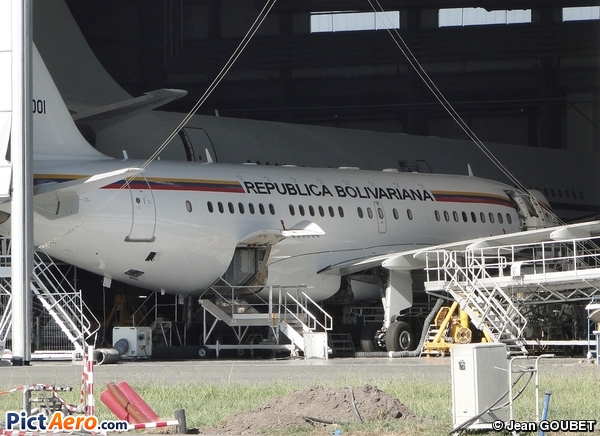
The other thing is that surprisingly he decided to explain why he was not travelling on the presidential Airbus, a plane that we see flying less and less. Capriles had asked about that, why Maduro flew in a Cuban plane instead of the presidential one, and Diosdado Cabello replied vulgarly as is his habit that it was none of his damn business. So we must be surprised that Maduro went back on that! Apparently Maduro discovered himself that there was a major flaw in the plane and he has decided to sue Airbus, basically implying that the corporation should be included in the "they" above.

You can imagine the flurry in the news and twitter.....

Let's see if I can come up with my choice of more likely speculations. Keep in mind that the Cuban G2 has taught the regime the technique of flying rumors, false truths, real lies and the like to confuse the adversary.

For the Airbus law suit I am almost tempted to see it as a tit for tat for the drug seized by Paris customs a week ago from the Caracas Air France flight. After all the street value is roughly comparable to a brand new Airbus and maybe Maduro had a stake in that shipment. Him or his associates, same difference. It is simply very unlikely that while an alleged refurbishing Airbus would have made such a crass mistake and even more unlikely that Maduro had an intuition on the technical aspects of the plane since he cannot even produce in public his birth certificate. I really cannot see any other explanation but a desire by Maduro to get back at president Hollande for wanting to bomb Assad in Syria and stealing his drug shipment.....

As for the sped up return from china, bypassing New York. Two possibilities, your pick.

First, the Cubans did not want Maduro to risk making a fool of himself in the UN. His defense of Assad and his own local crisis takes away any credibility he may have there and since he is prone to idiotic gaffes... Raul decided to send him on and mind the shop as things do not look good at all for the Cuban colony.

The other explanation is that taking advantage of Maduro's travel, some inner chavista factions started making some suspicious moves. You have everything there, from military upset that Maduro is a Colombian and wanting to make a coup to his rival Cabello trying to regain some of his lost ground. I personally do not think that a coup was planned, too crass, too cartoonish even for chavismo. But that some tried to take advantage of Maduro being away to shake a few things is not to be discarded. For example, they could have presented Maduro with a fait accompli of some economic decision that he was unwilling to take, or change some mayoral candidates, or....  Whatever it was, the sudden return of Maduro can only mean that he had a need to come back in a hurry for some major problem brewing.

Developing....

Nowhere to go for chavismo

It is always sobering when you read that even a firebrand like Marianella Salazar writes in a major paper about the possibility of a coup, naturally,  as if she were talking about what to do next Sunday after the family BBQ.  I do not know about her sources to take this eventuality such matter-of-factly, but one thing is certain: major governmental paralysis is only too often the surest sign of a regime/government change. Hit your history books.

The fact of the matter is that since Chavez left for Cuba the country has been basically on standby. For all the electoral pandering the lone economic decision of importance taken was the devaluation in February which has turned out to be a mere robbery as most private debt of 2012 at 4.3 to the dollar has been paid, if paid, at 6.3 to the dollar. A 40%+ robbery. True, there has been an attempt at reducing expenses though with misguided targets, and probably all efforts voided by the latest loan from China which is for electoral purposes, and once again, leaving us into yet more national debt (I have read 60% of PIB which is terrible for a country that produces nothing of value for export).


Whatever the real numbers are on the economy what we know for certain is that the inflation is killing us while the country infrastructure, without upkeep for a couple of decades is crumbling at a faster speed, from gaping sinkholes in Caracas streets to constant power outages. For those of us still trying to have our business produce something, anything, the fight is harder by the day. Between the increasing difficulty to obtain less and less dollars to purchase our raw materials we are subjected to a relentless assault of bureaucrats acting as free agents to skim whatever they can from us, legally or not, it really makes no difference at this point. For many manufacturing business these days, trapped between abusive price controls, impossibility to manage labor force, scarcity of raw materials, logistical nightmares, it is increasingly coming down to meet payroll or pay our providers. Since by law we must do both then private debt increases or payroll is cut down, generating more social stress.

All of these is felt by the population which is realizing that the regime is simply unable to take any major decision. The regime is trapped into the prospect of radicalizing its system and accept state bankruptcy and the consequent repression that will be needed to control the masses; or the regime can start applying a dose of reality to state management, implicitly admitting that the bolivarian fraudulent revolution is over. The question thus, the real question, is why soon one year after the departure of Chavez the regime is unable to make up its mind.

I am offering one explanation here, of the many possible: chavismo is on the verge of fracturing itself. In Venezuelan history the break up of political parties is a recurrent theme. AD did it several times. Copei did it only once but it cost it its future. Even parties that did not make it to office managed to divide themsleves, such as Causa R, and even Primero Justicia when Lopez left. There is no accident that Venezuelan ballots offer dozens of political parties.

Specific chavismo, the PSUV, cannot escape that fate, the more so that it was founded as a support for Chavez, never along a strong ideological program, or at least a country objective. If the ambitions of Maduro and Cabello have been apparent and determined the inner struggles of 2012 and the first half of 2013, we cannot fail to note that chavismo itself was never able to unify the Venezuelan left, as many parties claiming that image still exist within chavismo (like the Communist party and other assorted small groups). Amen of the left that never joined chavismo or abandoned 2007, or even earlier.

I think that one reason why the regime is unable to take real political and economic measures is that any it may take will alienate one of the branches of chavismo and cause a break up. Since all inside know that a break up is a sure way to be booted out of office, they stick together at all costs, in particular the even higher cost of paralysis which is a slower way to be dismissed from office but the surest one.

The genius of Weil at Tal Cual
Values or corruption
Production or importation
Spending or investment
Debt, debt, debt....


Monday, 23 September 2013

The electoral future of chavismo as seen in East Germany

So we had a smashing victory for Merkel yesterday in Germany though it will be rather difficult for her to establish a solid coalition since she blithely disposed of her FDP allies. But that is her problem. What is more interesting for this electoral maps freak are the gorgeous voting maps results published all around.  In Speigel I found this one that made me think a lot: the percentile results for Die Linke.

See, Die Linke is the freak far left party founded by those who never digested the end of commie East Germany. True, they did try to improve their brand with a few SPD dissidents but the result is that contrary to what happens in France with Front de Gauche, no one wants to be caught dead with Linke leadership. Not the SPD, not the Greens and less the CDU of the FDP.


So, the West Germans brought them freedom, repaved their roads, brought real welfare that works even if limited, made sure electricity and heating were available, that there were many bratwurst brands available at the grocery store, etc...  but also brought to East Germany work ethics and the like. Heck, even the Kanzlerin is from East Germany. Apparently that has not been pleasing for many, up to 20% + in some areas (deeper lilac color). Thus East Germany still exists in electoral maps, with a lighter small island of former West Berlin.

This is what I expect will happen in Venezuela where a hefty percentage of the population in 15 years have been told to expect all from the Chavez state with little if any work to be shown for it, besides attending occasional beer drenched political rallies. Thus there might not be a specific red area in Venezuela but there will be for decades to come a red hue all across the country that will try to sabotage any recovery process that we may try once we finally get chavismo out of office.


Monday, 9 September 2013

Can Maduro last long?

For the last few days I was mulling a post on how long the chavista regime could survive. (Note: that it survives a week or ten years is not the real point, what we are discussing here are the means it uses for its survival).  But Miguel sort of hopped ahead even though his post is lacking addressing the motivation of these people "[they have] no scruples". Really.....  Still, Miguel covers quite well how the regime can muddle his way through financially for quite a few more months or years, and thus there is really nothing I can add on this respect. However, on other aspects there is a whole lot more that can be added as to reasons why the regime may survive longer than logic would dictate.


To understand what comes next it is good to remind that the regime is a thug-ocracy, that those in charge are a whole bunch of people that have stolen so much that they know perfectly well that if the country ever gets back to normal they will go to jail. In other words, the people in charge cannot conceive any scenario in which a peaceful transition will come and they will be allowed to go unscathed. As such they are ready to do whatever it takes to stay in office. Murder not being an exception since the already existing high crime rate would allow for an "oops! Capriles was unfortunately shot dead when someone tried to steal his blackberry" (ten cases a day in the country, just replace "blackberry" by smartphone X and "Capriles" by your favorite political leader, journalist, neighbour, etc.)

If plural murder and bloody repression á la Syria have not taken place yet it is indeed in part because of the oil money still coming in. It might be seriously diminished but at 100+USD a barrel there is enough to smooth over the most pressing issues, or at least to throw enough bones to postpone the day of reckoning.  But there are many other reasons why the regime is not going to crumble: simply there is no will to push it over the cliff. Many culprits here.

The military is the very first group that have allowed the country to become the cesspool of corruption and incompetence that it has become. Not that I am advocating, by any means, a coup: those that would perpetrate a coup are simply scum, worse than Maduro and his combo. And also, for all practical purposes, WE ARE ALREADY UNDER a military regime anyway, albeit one that did not need to make a coup in its grab for power. Chavez served it on a platter to them.

What I am referring to is to is what should be a serious military, one that is able to express discretely its concerns on delicate issues and tell any government which are the No-Noes on national security issues. For example, a serious military would have opposed the conversion of the country into a narco state. It would not have allowed Cuban meddling beyond medical and sports personnel. It would not have given up the Essequibo region under claim against Guyana. Certainly, it would have allowed some corruption, land expropriations, constitutional violations, and the like that are civilian responsibility; but at least on matters of national security it would have drawn the line. What is damming in the military silence and collaboration is that the consequences are synergistic: corruption, independence, incompetence are much more damaging than if the military had had the good idea to stay clear of Chavez, which it could have, even after the 2002 fiasco.

To hope anything from the military today, as many still pretend, is simply delusional. The Venezuelan military has allowed himself to become a political body, deeply flawed, deeply corrupt, probably irrecoverable. A new government will have the painful decision to either confront them and eliminate the army, or to allow the same dependency to continue. And as a narco state which has absolutely no qualms whatsoever, I am afraid that we are doomed. The only thing we can hope is that the military gets tired of the general decrepitude of the country and allow a change in its leadership as long as its privileges are preserved. I suppose, in a way, that could be seen as an improvement on our current conundrum.

The second group is the judicial system. That it has allowed itself to be co-opted as it did will remain one of our biggest historical shame. That what has happened to a couple of judges, one of them being judge Afiuni, was enough to silence the thousand of justice workers is simply incomprehensible. True, it happens in many dictatorships where the judicial system offers meek, if any, resistance, from Chile to Germany. But those dictatorships were of the "right" nature as "left" dictatorships usually removed judges outright and that was that. Venezuela will be the text book case on how leftists regimes can take over a judicial system without much trouble. Now we even see pitiful images of a formerly respected legal scholar, Rondon de Sanso, writing cheap panegyrics on Chavez, and even circumstancial poetry, I suppose to defend indirectly her hyper corrupt son in law, Rafael Ramirez. She went even as far as saying outright that not everybody deserves the right to a defense. Not only the Venezuelan judicial system has become a dead weight for recovering democracy, but its mere passivity is enough to help the criminals in office without needing much active support from tribunals.

The third group is the beneficiary of direct, massive corruption. It may not be that big, it may even include people that would normally vote against the regime, but it has power in that it can finance politicians it need to preserve its privileges. The problem with these people is that they have stolen so much that they cannot care less anymore about what happens to the country.  Let's take the latest example of the "bolibourgeois" of Derwick Associates who have overpriced power generating gear, stolen, let's not be afraid of words here, hundreds of millions of US dollars. Does anyone think that the kids that stole such amounts care one way or the other if people starve in Venezuela? If civil war starts? No. All their actions in defending themselves of the charges indicate that they are trying to find ways to steal yet more millions.

But the last group is the largest one and the most worrisome of the lot. To really have a sense of that group you probably need to live outside of Caracas, and to have regular contact with some sectors of "el pueblo". What casual and not so casual observers are failing to grasp is that some of the abuses and inefficiencies of the ruling chavismo are increasingly perceived as "normal", the ways things are and should remain. In short, after 14 years of pseudo revolution and misrule, a large chunk of the chavista vote has become a conservative vote, in the stricter sense of the term, to keep the status quo, to have a knee jerk refusal of any change.

It is difficult to characterize this group, even more to label them no matter how many labels one tries to make up. The fact of the matter is that these people got used to live in the situation they are, developed survival mechanisms, and are acutely aware that any change will take years to improve their lives.  For example, the work situation. For many people outside of Caracas it is clear that there are no jobs out there worth applying to. The private sector has all the trouble in the world to maintain its payroll, or is trying hard not to increase it considering the new prohibitive labor law and regime bias against employers. Simply put, if you have not belonged to a real payroll in the last 2-3 years it is almost impossible for you to get a job, even inside government as these jobs are reserved for the increasing number of "graduates" from bolivarian "universities" with mickey-mousy degrees.  However you can still have access to Mercal and other freebies as long as you keep voting for chavismo, or so you were convinced to do.  Basically, for the average familial units of that group, life depends maybe  from a single meager income, the others share in and stand in line for the occasional freebies.

Standing in line....   This has become a national sport. The habit seems to be now ingrained and I am getting tired of seeing those lines all the time, even at working hours which tells you volumes of the job scarcity.  But what is worse is that people have stopped complaining, and not only they are taking it in stride but apparently they have no problem spending the night in line to make sure that they get a number for next day, or the day after even. That magical day after number ensures that they will get something (meat? oil?) that they cannot get in the "normal lines" (corn flour? margarine?).

I do not know how to explain this social phenomenon that the opposition is careful not talk about because there is little they can do.  But for many Venezuelans now it has become "normal" to stand in line for anything they need, from food to medical care, with the aggravating factor that manyseem unable to link that with the economic failure of the regime.  This is what gradualism and 14 years of brain washing and media restriction do to a country, a new "normalcy".

Thus we reach the end of this post. What I hoped to convey is that there is a gigantic inertia against regime change. Maduro benefits from a large group of people that may not be happy with their lot but who for many reasons see no point in changing the way things are. Note that I did not discuss those who actively fight to block any regime change such as the talibans, the politicians that now they have no future if they find themselves in the opposition, those who vote for Chavez for some obscure need for revenge, etc... I am only talking of those who actually could do something but chose not to do so.

True, the social situation is explosive, polls are falling fast for Maduro (for a regime based on the charisma of Chavez a 2 point poll drop is like a 10 point drop in a normal democracy). There are also many potential fuses to provoke the social explosion, or merely an electoral reversal so big that not even fraud can keep the corrupt combo in office. However there are enough factors dampening the fuse that even if one of them were to be lighted up there is no telling when its effect could be felt. Maduro could last until December or for the full six years terms. He can fall bumped out by the opposition or by an internal chavista conspiracy. There is simply no telling. What is certain is that there is an unexpected inertia in his favor. Not love, but the next best thing for a politician, inertia.




Saturday, 3 August 2013

Is Venezuelan opposition dragged into a coherent strategy?

The end result of this week may be unexpected. Both sides accumulated failure after failure and yet, the opposition may have come on top significantly with the real tool it needs most: a strategy.

The regime accumulated failure after failure, clearly. The undeserved prosecution of representative Mardo was perceived by most in the country as a at best a distraction move from dire reality and at worse an unspeakable abuse of power from people that had no moral grounds for that.  Then, as a knee jerk reaction, the most corrupt regime in Venezuela's history called for a rally against corruption. This rally this morning was by all accounts a failure, as seen on TV. And to complete the day it was announced at the post march rally that the communication minister, a charismaticless journalist, has been named the candidate for Greater Caracas Mayor without consultation and even less of a primary; with the added contradiction that the regime has wanted to destroy that position for the last 4 years and that suddenly it wants it. The accumulation is synergistic and we may have a major political mistake from the regime, a mistake that may be of major consequences.

The opposition errors come more for their erratic organization and centrifugal forces. Mardo may have seen as a victim but he did not raise by himself major sympathy. After all, no politician that keeps bouncing from any elected office to another one rarely garner respect except perhaps from his constituents that know him better. The national attention he garnered was from what was done to him more than any martyrdom essence. A normal opposition would have been divided on that matter but the aggressiveness of the regime had the opposite effect: it showed quite a united front this week. Yet, once Mardo was done in by the Assembly the opposition hurriedly and unwisely called for a few actions across the country.

I can verify that in San Felipe the local rally never reached 100 people. It was ill planned, in an unsuitable spot, at a terrible time for the habits of the town that has Saturday morning as THE shopping time of the week. Mardo counts of little when your chance to get scarce goods coincides with the rally.  That small group was so out of place and out of touch with the concerns of San Felipeños that it probably was counterproductive. The Caracas event was not even a march, but as a gathering it got a respectable attendance. Though not worth writing home about. What saved the day was that it visibly had a bigger draw than the one from the regime, who, by the way, did nothing worth noting outside of Caracas. The opposition carried the day because it failed less. Much less in fact.

The result of all this, of the clear intention of the regime to erase the opposition as needed, is that finally this one is getting is ideas in place.  Today Capriles officially put himself behind a constitutional change call but with the cleverness of putting a condition: the opposition needs to win the mayor elections in December if it wants to have a chance to effect those constitutional changes. Thus the strategy is set: bring in the radical vote by telling them that unless they rally first for December their proposals will be put moot after. That way the hope is to minimize opposition abstention while the individual teams for mayor and councilmen candidates should be more efficient to limit the regime's fraud. Then, obviously for all, with a 100+ mayor it will become much easier to raise the signatures needed for constitutional reform and get the votes after.

I personally think that it is the lone way to avoid a new disaster in December. As long as the concerns of the more radical groups inside the opposition, or the mere disgust of people like me are not taken into account there is no chance to perform decently in December no matter what the polls say today. It even works to attract some chavista that are disgruntled enough to vote for the opposition in December just to force the regime to sit down and negotiate an agreement with the opposition to avoid a constitutional conflagration. And the beauty of it is that there is enough time to make this strategy prosper until December.

Let's not be blind to the reality: the hysterical power show of the regime this week, the crass attempt at creating a good corruption versus a bad corruption cannot hide the inherent weakness of this one. The regime suffers already of two strikes against: no leader able to replace Chavez and a terrible economic inheritance that the lack of leadership makes it impossible to tackle. To this the regime adds a major error: no primary to decide mayor candidates, and worse, to decide councilmen candidates where many want in. All will be appointed from Caracas.  In current political language in Venezuela this means a probable fatal abstention for the regime in December as this one comes along as self serving, as defending the privileges of those already in office, not making room for new ones, not sharing the now scarce benefits.  And this just at a time when the opposition may have found a way to minimize its own losses.

Even though on a foul mood through the week, tonight I find myself surprisingly optimistic.

Monday, 29 July 2013

Vagabunderias y permanente subdesarrollo chavista en Venezuela

Este fin de semana vimos dos cosas que deberían dejar pensativo a muchos en Venezuela. De un lado nos decretan un tal Instituto de Altos Estudios del Pensamiento de Hugo Chávez y por el otro leemos que analistas piensan que Mexico es el mejor candidato para ser un líder en tecnología, un Silicon Valley Latinoamericano. Empecemos por el segundo que es mas prometedor de futuro.

Para crear un valle de la silicona (y no de la usada por la estética que para eso Venezuela si está posicionada) se necesita talante humano, una masa critica de creadores, estabilidad y garantías jurídicas y preferiblemente cercanía al principal inversionista en la materia, sea Europa o EE.UU. México gana según el artículo. ¿Porque pierden los otros?

Chile, a pesar de su desarrollo, pierde por su poca población y su distancia. Perú y Colombia porque arrancaron la carrera tecnológica tarde. Argentina, que se supone hubiese sido un excelente candidato, tiene una economía y sociedad en franco deterioro mientras que los otros están en franca expansión. Los otros países son demasiado pequeños, obviamente. ¿Pero porque pierde Brasil frente a México? Porque México tiene un ambiente mas favorable a la creación intelectual, porque es mas fácil crear empresas que en Brasil, porque hay protección contra piratería. Y agregaría yo porque Brasil todavía se satisface mucho con ser exportador de materias primas semi transformadas mientras México entendió que ya no le es posible.

¿Y Venezuela? El articulo no la menciona a pesar de tener población superior a Chile, a pesar de tener recursos mas accesibles que Perú, a pesar de no tener (todavía) guerrilla mortal como en Colombia. Este artículo sencillamente nos recuerda otra vez mas que Venezuela se ha vuelto irrelevante en la economía mundial, a pesar de sus ventajas petroleras y de su cercanía a los mercados desarrollados.

Lo mas triste en este asunto es que Venezuela no tiene perspectivas de mejoría, ni siquiera en el largo plazo. Mas que nunca somos una economía basada en la exportación de una única materia prima. Estamos hoy en un sistema que cierra el paso a la innovación y la tecnología porque la corrupción y la ignorancia nos carcomen. Nuestra base educativa crea graduados de un sistema de gobierno cuyos títulos no valen nada mientras que los centros donde todavía si se puede estudiar careras productivas están asfixiados porque no se quieren rendir ante una ideología ya descompuesta.

Ante este desolador panorama para nuestro país, ayer nos dieron otro golpe. El Instituto decretado por Maduro va a estudiar el pensamiento de un tipo cuya violencia dividió a nuestro país, que creó una corrupción material inaudita para sustentar una corrupción peor, la política y moral.  El tipo ha pasado sus 14 años de poder en cortar la cabeza a cualquier innovador que despunte, que le cree la mas mínima sombra. Hugo Chávez a pasado su vida entera en retrotraer Venezuela al caudillismo del siglo XIX, y por si fuera poco, la convirtió al final en colonia del país más atrasado de América Latina: Cuba. Ahora se pretende que la cháchara que Chávez eructó durante 14 años se destile en un "pensamiento" preciso que, imaginamos, servirá de excusa para mantenernos en la esclavitud de la ignorancia.

¿Cual esperanza?

Sunday, 28 April 2013

Chavismo: from XXI century socialism to XXI century fascism

Perhaps it is inaccurate to start a post on ideology pretending that chavismo is one. There is no such thing as "chavismo" besides the unconditional love and tolerance of his groupies for any inaneness that Chavez blurted since 1992.  Chavez changed many times his speech, admitted to too many influences and thus implied a lack of understanding of what he read, making him unable to forge some kind of basic coherent ideology that could survive him. Then again, it was quite possible that he never planned for his "post-me" era, that he always thought that his message was obvious, even when he got sick and knew his days were numbered. Such was his ego that we could assume that to be true.


Chavez always was more nationalist than anything else, nationalist of the crass variety,  the one where "we are better than any other and all of our problems are provoked by others". The lack of Jews in Venezuela and the long tradition of faux-pas of the USA in Latin American history pushed him obviously into a primal form of anti USA, a noted offer in a country that was a solid ally of the US, but never an unconditional one. But as his regime developed a simplistic anti US policy was not enough and once Chavez survived the 2002-2004 instability he surrendered to the Castro-Cuban influence.

Chavez certainly adopted some leftist standards in his speeches from the start for one very single reason: since 1958 no Venezuela politician had ever succeeded in Venezuela with a personal responsibility and business platform. That once in office something else was practiced is another matter: but to reach the presidency in Venezuela you always needed a populist discourse, which meant borrowing cliches from the left. At heart Chavez was always an authoritarian first, a nationalist second and a leftist third. Even the decision to use democracy to destroy it was a decision that did not come easily to him., so reluctant he was to tame his power pulses.

It was in 2004 when truly started the alleged leftism of the regime with massive expropriations and cute inventions such as "cooperatives" schemes now long forgotten. Also, it was in 2004 that terms such as "socialism of the XXI century"  started to be forged. After his 2006 reelection Chavez finally proclaimed himself a socialist.

In spite of his professed admiration for leftist icons like Fidel, or leftist military juntas like Velasco Alvarado, the socialism of the XXI century was never very convincing and was really nothing more than an extreme form of populism, á la Peron if you want an historical reference. Under Chavez what we saw was a massive corruption that resulted in the creation of a new economic elite associated with the regime while the real improvement in the social conditions of the masses was of cosmetic quality, certainly not sustainable as the economic record has made it perfectly clear now when Venezuela more than ever in its history has become dependent of a single crop from the earth, oil.

But Chavez was not changing his positions anymore. He had created a clientele system where his power was based on getting according to the merits they gained at the service of a revolution that never truly existed. Ideology in such situation is really not needed and whatever was in place by 2006 remained, simply used as a mask to hide the true nature of the regime: an authoritarian presidency for life which rests upon a limited elite willing to do all the dirty work for the Supreme leader. The perversion of Chavez system, his final paradox was that the loud nationalist surrendered the control of the country to Cuba to the point of going to die when necessary.

Thus the problem for his successors is what to do with the "ideological" mess left behind. With the Cuban influence and decades of young Venezuelans gone to Cuba for "training", including Maduro himself, there is certainly going on an attempt to radicalize further the regime towards a communist hue. After all, even Fidel himself recognized in a noted interview to Venezuela pro Chavez journalists that "XXI century socialism" was nothing more than XX century communism.

Unfortunately the XXI century adjective makes a shift towards communism nearly impossible. Venezuela is not an island like Cuba, and the world is globalized even if the regime has made our internet one of the most expensive and less functional of the continent, on purpose.  Also, that client nature where people, contrary to Cuba, expect more than just food, combined to a powerful corrupt class that likes to show off its wealth makes it difficult to radicalize the discourse in a Communist way. Even the pet project of Chavez where the country was going to be divided in "Comunas" has left everyday language. The struggle inside chavismo is thus a decision between XXI communism and XXI century fascism. Fascism is a more applicable system to today's Venezuela, even if the F word is supposedly representative of the democratic opposition in official propaganda. But historical fascism has had never any problem of accusing the other side of their very own vices. We should also not forget that fascism and communism meet in their totalitarian extremes and Castroite Cuba could find many ways to accommodate comfortably a XXI century fascism.

We can look at how close to fascism chavismo is today by simply looking at this oversimplifying folk encyclopedia  Wikipedia. In a lengthy entry they cite, for example, a handy top 10 list to describe historical fascism (cited from Emilio Gentile). Certainly, XXI century fascism is going to be different, adapted to current reality but for the sake of it, let's look at that top 10 of historical fascism and not coincidences:
1) a mass movement with multiclass membership in which prevail, among the leaders and the militants, the middle sectors, in large part new to political activity, organized as a party militia, that bases its identity not on social hierarchy or class origin but on a sense of comradeship, believes itself invested with a mission of national regeneration, considers itself in a state of war against political adversaries and aims at conquering a monopoly of political power by using terror, parliamentary politics, and deals with leading groups, to create a new regime that destroys parliamentary democracy.
Well, clearly we see a lot of that in current Venezuela. Chavismo is multiclass because it goes from the poor to the nouveau bolibourgeois rich; it has a party militia although it is not efficient and tied to the army as a "reserve"; it has a self attributed mission of national regeneration; the "state of war" agaisnt poltical adversaries has become a tired cliche; parliament has been annulled; etc...
2) an 'anti-ideological' and pragmatic ideology that proclaims itself antimaterialist, anti-individualist, antiliberal, antidemocratic, anti-Marxist, is populist and anticapitalist in tendency, expresses itself aesthetically more than theoretically by means of a new political style and by myths, rites, and symbols as a lay religion designed to acculturate, socialize, and integrate the faith of the masses with the goal of creating a 'new man'
This is not as clear though some of the anti are included, and the nascent Chavez cult might be unto something.
3) a culture founded on mystical thought and the tragic and activist sense of life conceived of as the manifestation of the will to power, on the myth of youth as artificer of history, and on the exaltation of the militarization of politics as the model of life and collective activity.
From the Bolivarian cult (frowned upon by true commies which has explained the lower reccurence in current discoruse) to the alliance of "pueblo y ejercito", we can check this one also.
4) a totalitarian conception of the primacy of politices, conceived of as an integrating experience to carry out the fusion of the individual and the masses in the organic and mystical unity of the nation as an ethnic and moral community, adopting measures of discrimination and persecution against those considered to be outside this community either as enemies of the regime or members of races considered to be inferior or otherwise dangerous for the integrity of the nation
Chavez always claimed that politics was all that mattered, even in his integrationist schemes for Latin America. In his reelection of 2012 in fact politics and him at the helm was the core of his campaign since he could not run on his material record. If the ethnic element is impossible to introduce convincingly in such a mixed blood country as Venezuela, it remains that chavismo has promoted antisemitic feelings in Venezuela while promoting racial preferences for those closer to their african or native origins.
5) a civil ethic founded on total dedication to the national community, on discipline, virility, comradeship, and the warrior spirit
6) a single state party that has the task of providing for the armed defense of the regime, selecting its directing cadres, and organizing the masses within the state in a process of permanent mobilization of emotion and faith
7) a police apparatus that prevents, controls, and represses dissidence and opposition, even by using organized terror
8) a political system organized by hierarchy of functions named from the top and crowned by the figure of the 'leader,' invested with a sacred charisma, who commands, directs, and coordinates the activities of the party and the regime
 All of these have been attempted or established with varying measure of success.
9) corporative organization of the economy that suppresses trade union liberty, broadens the sphere of state intervention, and seeks to achieve, by principles of technocracy and solidarity, the collaboration of the 'productive sectors' under control of the regime, to achieve its goals of power, yet preserving private property and class divisions
 More than any communist approach to the means of production in theory under control of the workers, chavismo has clearly had a policy of state capitalism which has become simply a state control over the economy where the capitalist concept of efficiency was ignored to benefit the necessary corruption to secure support from the new elite. If private property and preservation of class division are banned form the official speech it remains that these are worse than ever: private property is only the one of those close to the regime and class division is a strictly enforced reality but through politics rather than economic criteria (the Tascon list is still alive and well, and used actively since April 14 in public administration for purging "undesirable" elements).
10) a foreign policy inspired by the myth of national power and greatness, with the goal of imperialist expansion
Certainly today it is the most difficult item to execute but Chavez has never hidden his desire to resurrect a "Gran Colombia" and has sponsored all sorts of internal organizations based more on politics and his interests than actual national needs.

In the last two weeks, in fact, since Chavez last trip to Cuba, signs of increased fascist outlooks are there. We cannot say yet whether this is on purpose, whether the excesses are still mostly due to disarray and inability to come to grip with the departure of the overwhelming leader, though I personally think that there is an open fight between the two totalitarian options within chavismo even though both claim to operate in the name of the people and under a leftist cover.  We have already characters that operate clearly along fascist lines, such as Diosdado Cabello at the National Assembly or Cilia Flores, the partner of Maduro, who is already busy placing her relatives and friends to key positions. We have some lefties who are acting in totalitarian ways like minister Molina threatening his employees, looking strangely fascist, arm band included.

Certainly an official "XXI century fascism" appellation is not possible. But let's entertain the thought that if Maduro et al. manage to survive their fraudulent election and retain office, their only way to remain on top will be though a mechanism of repression and social organization that will be closer to fascism than anything else since communism will even be less likely to be applied once the Castros die. Since they cannot call it XXI century fascism they will call it "chavismo".

The irony here is that what Chavez was unable to codify will be codified by his heirs who will be only too willing to put their excesses and abuses under the name of their former leader. Chavez crimes after his death will be worse than those he committed while alive.